
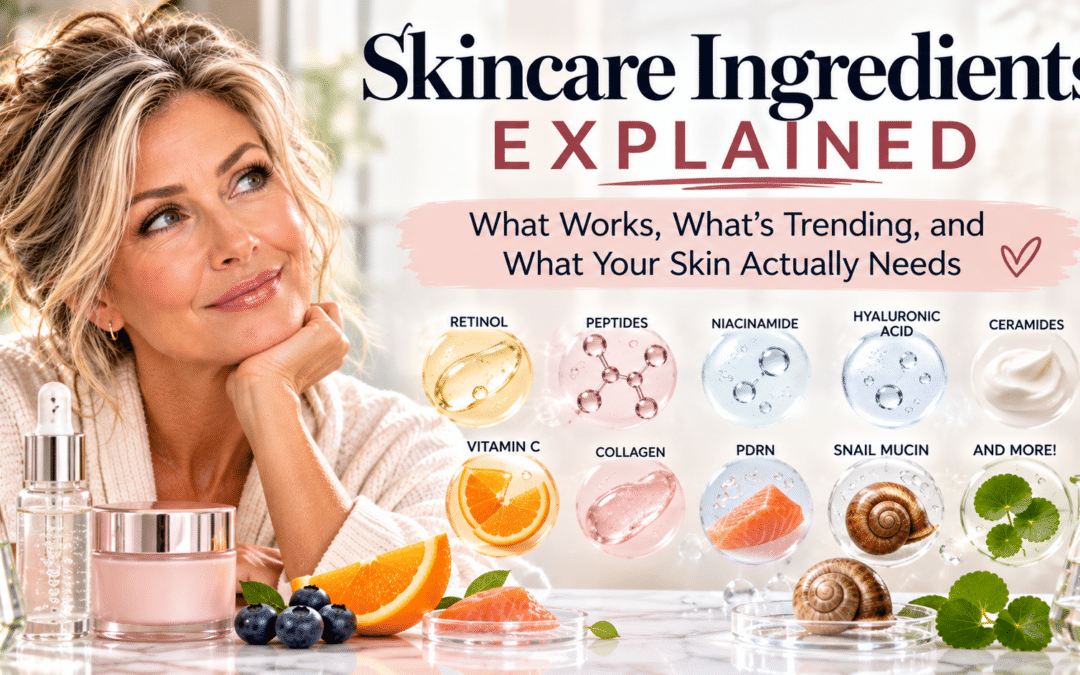
Peptides, retinol, hyaluronic acid, PDRN, collagen, and niacinamide are showing up in skincare conversations everywhere. But which ingredients deserve a place in your routine?
Updated October 2026 | By Jennifer Marshall, Mary Kay Independent Beauty Consultant
If you’ve been shopping for skincare lately, you’ve probably noticed something interesting.
We’re no longer just shopping for moisturizers, cleansers, and wrinkle creams. We’re shopping for ingredients.
Peptides. Retinol. Niacinamide. Hyaluronic acid. Ceramides. Collagen.
And now, thanks partly to Korean skincare trends, we’re hearing about ingredients such as snail mucin and salmon-derived PDRN.
Some of these ingredients have decades of research behind them. Others are relatively new to mainstream beauty conversations.
So how do you know which ones are worth your attention?
The answer starts with understanding what each ingredient can realistically do.
Why Skincare Ingredients Are Getting So Much Attention
Today’s consumers have more access to ingredient information than ever before.
Search engines, social media, dermatologists, beauty creators, and artificial intelligence tools all contribute to the conversation.
People are asking increasingly specific questions:
- What ingredient helps with skin firmness?
- What’s best for dehydrated skin?
- Can a cream really stimulate collagen?
- Should I use retinol or peptides?
- What helps protect the skin barrier?
- Is salmon DNA skincare effective?
These are good questions because the same ingredient isn’t necessarily appropriate for every skin concern.
It’s also important to understand the difference between an ingredient becoming popular and an ingredient being clinically proven to work.
Search interest tells us what people are curious about. Clinical research tells us what evidence supports a particular benefit.
Both matter, but they answer different questions.
Skincare Ingredient Comparison: What Does Each One Do?
|
Ingredient |
Main Cosmetic Purpose |
Most Relevant Concerns |
Evidence Perspective |
|
Retinol |
Improves visible photoaging and texture |
Fine lines, uneven tone |
Stronger established evidence |
|
Retinal |
Vitamin A treatment for visible aging |
Fine lines, texture |
Retinoid evidence; product-specific results vary |
|
Niacinamide |
Supports barrier and more even-looking tone |
Redness, dullness, oiliness |
Established ingredient evidence |
|
Vitamin C |
Antioxidant and brightening support |
Dullness, uneven pigmentation |
Established, formulation-dependent |
|
Hyaluronic acid |
Attracts and holds moisture |
Dehydration, dryness lines |
Established hydration evidence |
|
Ceramides |
Support barrier lipids |
Dryness, moisture loss |
Established barrier-support evidence |
|
Peptides |
Targeted skin-conditioning and firmness benefits |
Visible aging |
Promising; depends on peptide and formula |
|
Collagen peptides (topical) |
Moisturizing and conditioning |
Dryness, surface softness |
More limited for deeper structural effects |
|
PDRN |
Emerging skin-conditioning ingredient |
Hydration and appearance of aging |
Limited evidence for ordinary topical cosmetics |
|
Snail mucin |
Moisturizing and conditioning |
Dehydration, dry texture |
Emerging, formulation-dependent |
|
Centella asiatica |
Soothing skin care |
Sensitive-feeling skin |
Promising but formulation-dependent |
|
Ectoin |
Hydration and environmental stress support |
Dryness, sensitivity |
Developing evidence |
|
Copper peptides |
Targeted skin-conditioning |
Visible aging |
Limited clinical evidence |
|
Azelaic acid |
Helps with blemishes and uneven pigmentation |
Acne, redness, dark spots |
Established dermatologic evidence |
Important: These descriptions are general ingredient characteristics. They do not establish that every product containing an ingredient produces the same results.
1. Retinol and Retinal: The Vitamin A Family
Retinol has earned its reputation because its topical version has been studied extensively for visible skin aging.
Retinoids influence processes associated with skin-cell turnover and can help improve the appearance of fine lines, uneven pigmentation, and rough texture.
But there’s more than one form of vitamin A.
Retinol is absorbed into the skin through several steps before becoming retinoic acid, the biologically active form.
Retinal, or retinaldehyde, requires fewer conversion steps.
Does that automatically make retinal better?
No.
A well-formulated retinol product can outperform a poorly formulated retinal product. Its concentration, stability, packaging, and tolerance all influence results.
What to consider before using a retinoid
Retinoids may cause temporary dryness, flaking, or irritation, particularly when starting the product.
Follow the manufacturer’s instructions, avoid introducing multiple irritating products simultaneously, and use broad-spectrum sunscreen during the day.
Retinoids are generally avoided during pregnancy; consult a healthcare professional if pregnant, planning pregnancy, or breastfeeding.
Mary Kay product to explore: Clinical Solutions® Retinol 0.3.
2. Peptides: Can They Really Help Skin Look Firmer?
Peptides are short chains of amino acids.
Some are used in skincare formulas because they may influence processes associated with skin’s appearance, including firmness and smoothness.
But not all peptides are identical.
A biomimetic peptide, a copper peptide, and a collagen peptide may have different functions and different levels of research support.
A 2026 systematic review of peptide interventions found encouraging results for certain skin-aging outcomes, but only two of the nineteen included trials studied topical peptides. That limits how confidently the overall findings can be applied to peptide creams and serums.
What about Mary Kay’s Volu-Firm® Complex?
TimeWise Repair® Volu-Firm® features a complex that includes:
A biomimetic tripeptide: Studied in laboratory testing for its ability to support collagen and elastin production.
Alpinia galanga leaf extract: A botanical ingredient studied for its effects on proteins associated with skin firmness.
Plant stem cell technology: Studied for effects involving hyaluronic acid production and degradation.
These are interesting formulation technologies, but laboratory ingredient findings should not be confused with demonstrated rebuilding of collagen or elastin in people using the finished products.
Mary Kay product to explore: TimeWise Repair® Volu-Firm® Collection.
3. Hyaluronic Acid: Why Your Skin Loves Moisture
Hyaluronic acid is a humectant.
That means it attracts and holds water.
HA is naturally found in the skin, and it contributes to hydration.
In skincare, hyaluronic acid is commonly used to improve surface hydration and help skin look temporarily smoother and plumper.
Different molecular weights may behave differently.
Higher molecular weight forms tend to act primarily at the surface, while certain smaller forms can deliver moisture into the outer skin layers.
Is hyaluronic acid only for dry skin?
No.
Oily skin can also be dehydrated. Oil production and water content are different things.
Someone with oily skin may benefit from a lightweight hydrating formula, while someone with dry skin may need additional ingredients that reduce moisture loss.
Mary Kay product to explore: Clinical Solutions® HA + Ceramide Hydrator.
4. Ceramides: The Skin Barrier Conversation
Think of the skin’s outer layer as a protective structure.
Ceramides are part of the lipid mixture that helps maintain that structure.
They help with moisture retention and normal barrier function.
When the skin barrier isn’t functioning well, skin may feel tight, dry, rough, or more sensitive.
Ceramide-containing products can help support that barrier, particularly when paired with other moisturizing ingredients.
Hyaluronic acid or ceramides?
They aren’t competitors.
Hyaluronic acid helps attract water.
Ceramides help support the barrier and helps reduces moisture loss.
A formula containing both can be especially useful for people concerned about dryness.
Mary Kay products to explore:
5. Niacinamide: One Ingredient, Several Benefits
Niacinamide is a form of vitamin B3.
It’s popular because it addresses several common skincare concerns.
Depending on the formulation, it can help support barrier function, improve the appearance of uneven pigmentation, and reduce visible redness.
It’s also useful in products intended for oily or combination skin.
Can niacinamide and vitamin C be used together?
Generally, yes.
The idea that these ingredients must never be combined is an outdated oversimplification.
However, whether someone benefits from using both depends on the formulas, their skin tolerance, and their concerns.
Mary Kay products to explore:
- Clinical Solutions® Ferulic + Niacinamide Brightener
- Special-Edition Snail Gel Face Patches
- Special-Edition Collagen Moisturizing Gel
6. Vitamin C: Still Relevant After All These Years
Vitamin C is an antioxidant used in skincare to help address uneven-looking skin tone and visible effects of environmental stress.
Some vitamin C formulations have evidence that supports improvements in the appearance of photoaged skin.
But vitamin C isn’t one single formula.
Vitamin C has different derivatives, concentrations, and delivery systems.
Stability matters because some forms of vitamin C degrade when exposed to air, heat, or light.
Does vitamin C replace sunscreen?
Absolutely not.
A vitamin C product may complement a daytime skincare routine, but it doesn’t replace broad-spectrum sunscreen.
Mary Kay products to explore:
7. Collagen: What a Moisturizer Can and Cannot Do
Collagen is a structural protein found in the skin.
It contributes to firmness and support.
Over time, natural aging and environmental exposure affect the skin’s collagen.
So it’s understandable that people want products promising to replenish it.
Here’s the distinction:
Applying collagen to your skin does not mean you’re replacing the collagen deeper within it.
Topical collagen can provide moisturizing and skin-conditioning benefits.
A well-formulated collagen moisturizer may leave skin feeling softer and looking plumper temporarily.
But it shouldn’t be presented as a substitute for the body’s own structural collagen.
Mary Kay product to explore: Special-Edition Collagen Moisturizing Gel, featuring collagen peptides, niacinamide, and squalane.
Read Mary Kay’s K-Beauty collection announcement.
8. PDRN: The Salmon DNA Skincare Trend
PDRN stands for polydeoxyribonucleotide.
It consists of purified DNA fragments, commonly sourced from salmon.
It’s become a notable ingredient in Korean skincare and aesthetic medicine.
Research involving PDRN has explored applications in tissue repair and skin-related treatments.
However, there is an important difference between medically administered PDRN and PDRN in a cosmetic product.
Method of delivery, concentration, and formulation affect what an ingredient can realistically accomplish.
A 2026 review of topical skin boosters specifically discussed delivery challenges and evidence gaps involving ingredients such as PDRN.
Does salmon DNA in a cleansing balm regenerate skin?
There’s no basis for assuming that simply because PDRN appears in a rinse-off cleanser.
A cleansing balm’s main purpose is cleansing.
Mary Kay product to explore: Special-Edition Melt-In Cleansing Balm, formulated with PDRN, rice bran oil, and vitamin E.
Learn about the K-Beauty Texture Edit.
9. Snail Mucin: Unusual Name, Familiar Skincare Goal
Snail mucin is a processed secretion derived from snails.
It’s popular in Korean skincare, particularly in moisturizing and skin-conditioning formulas.
The ingredient’s unusual origin makes it memorable, but its practical cosmetic appeal is relatively straightforward.
People want skin that feels hydrated, soft, and comfortable.
Research on snail-derived cosmetic ingredients is still developing, and the performance of any particular product depends on the formulation.
Mary Kay product to explore: Special-Edition Snail Gel Face Patches, featuring snail mucin, niacinamide, licorice extract, and multiple forms of hyaluronic acid.
10. Emerging Ingredients Worth Watching
Copper Peptides
Copper peptides, including GHK-Cu, are discussed for skin-conditioning and visible-aging benefits.
They are interesting, but human clinical evidence for many over-the-counter products remains limited.
Centella Asiatica
Often called cica, this botanical ingredient is associated with soothing and conditioning skincare.
It’s commonly found in products intended for sensitive-feeling skin.
Ectoin
Ectoin is a compound produced by certain microorganisms and used in skincare for hydration and protection against environmental stress.
It’s an emerging ingredient worth following.
Glutathione
Glutathione is an antioxidant receiving attention in brightening-related skincare discussions.
However, cosmetic claims involving significant changes in pigmentation require appropriate evidence.
Azelaic Acid
Azelaic acid is more established than many emerging ingredients.
It has dermatologic applications involving acne, redness, and uneven pigmentation, although strengths and regulatory classifications vary.
How to Choose Ingredients Based on Your Skin’s Needs
Rather than asking which ingredient is trending, start with what you’d like to improve.
|
Your Main Concern |
Ingredients Worth Understanding |
|
Dryness |
Hyaluronic acid, ceramides, squalane |
|
Dehydration |
Hyaluronic acid, glycerin, moisturizing gels |
|
Visible fine lines |
Retinoids, moisturizing ingredients, certain peptides |
|
Loss of firmness |
Retinoids, selected peptides; realistic expectations matter |
|
Uneven-looking tone |
Niacinamide, vitamin C, retinoids, azelaic acid |
|
Oily skin |
Niacinamide, appropriately formulated retinoids |
|
Sensitive-feeling skin |
Ceramides, gentle moisturizers, selected soothing ingredients |
|
Dull-looking skin |
Vitamin C, niacinamide, appropriate exfoliation |
These are starting points, not diagnoses or universal product prescriptions.
Frequently Asked Skincare Ingredient Questions
What is the best skincare ingredient for women over 50?
There isn’t one universal winner.
Daily sun protection, adequate moisturizing, and carefully selected treatments for specific concerns are generally more useful than choosing products based on age alone.
Retinoids have relatively strong evidence for visible photoaging, while hyaluronic acid and ceramides can be good for dryness.
Can you use peptides and retinol together?
Many formulations can be used within the same overall routine.
The appropriate combination depends on the specific products and how well your skin tolerates them.
Is niacinamide better than vitamin C?
Neither is universally better.
Niacinamide is useful for barrier support and uneven-looking tone. Vitamin C is an antioxidant with brightening applications.
The choice depends on your concerns and the formulation.
Can hyaluronic acid cause breakouts?
Hyaluronic acid itself is generally well tolerated, but any finished product can cause problems for some users.
Other ingredients and the overall formula may affect how a product performs on acne-prone skin.
Do collagen creams rebuild collagen?
Topical collagen is mainly useful for moisturizing and conditioning.
A collagen cream shouldn’t be assumed to replace structural collagen in the dermis.
Is PDRN the same as salmon sperm?
PDRN is purified DNA material that may be sourced from salmon reproductive tissue. The final cosmetic ingredient is processed and purified; it is not the same as applying unprocessed biological material to skin.
Are Korean skincare ingredients better than traditional ingredients?
Not automatically.
Korean beauty has contributed important formulation ideas and ingredient trends, but effectiveness depends on the individual product, not its country of origin.
Do expensive skincare products work better?
Price alone doesn’t establish effectiveness.
Formulation quality, evidence, tolerability, and consistency matter more.
How long does skincare take to show results?
Moisturizing effects may be noticeable quickly.
Changes in visible pigmentation, texture, or wrinkles may take weeks or months, depending on the treatment.
Do I need a ten-step skincare routine?
No.
For many people, a cleanser, moisturizer, broad-spectrum sunscreen, and carefully chosen treatments are a practical foundation.
A Simple Way to Build Your Skincare Routine
Morning
- Cleanse gently.
- Apply an appropriate treatment or hydrating product.
- Apply Day Cream
- Finish with broad-spectrum SPF 30 or higher.
Evening
- Remove makeup and cleanse.
- Apply your selected treatment according to directions.
- Apply Night Cream
Additional products can be added to this routine when they serve a clear purpose.
Final Thoughts: Better Questions Lead to Better Skincare Choices
The skincare industry will continue introducing interesting ingredients.
Some will become established favorites. Others will eventually disappear from the conversation.
But understanding what an ingredient does, what evidence supports it, and how it fits into a routine will always be useful.
Before buying another product, ask yourself:
What does my skin need, and how will this product help?
That’s a better starting point than following every new trend.
Need Help Choosing?
As a Mary Kay Independent Beauty Consultant, I help people explore skincare options based on their concerns, preferences, and existing routines.
Whether you’re curious about the latest Korean skincare ingredients or prefer an established regimen such as TimeWise Repair® Volu-Firm®, I’d be happy to help you compare options.
Visit [jenmarshallmk.com](https://jenmarshallmk.com) to learn more or request a personalized skincare consultation.
Jennifer Marshall | Mary Kay Independent Beauty Consultant
References and Further Reading
- Skincare Ingredients Recommended by Cosmetic Dermatologists: A Delphi Consensus Study. 2025.
- Oral and Topical Peptides for Skin Aging: Systematic Review and Meta-Analysis. Frontiers in Medicine, 2026.
- Topical Skin Boosters in Aesthetic Practice: Delivery Platforms and Evidence Gaps. Cosmetics, 2026.
- Topical and Systemic Skin Aging Interventions: Evidence, Pitfalls and Perspectives. 2026.
- International Expert Consensus on Integrated Skincare Active Ingredients. Journal of Cosmetic Dermatology, 2026.
- Mary Kay Introduces the K-Beauty Texture Edit. October 5, 2026.
- Mary Kay Clinical Solutions® Collection.
- Mary Kay TimeWise Repair® Collection.
- Mary Kay Clinical Solutions® HA + Ceramide Hydrator.
Disclaimer: This article provides general cosmetic education, not individualized medical advice. Ingredient research does not establish the same results for every finished product. Product formulations and availability may change. Always check current labeling and directions.